Istrian towns and villages

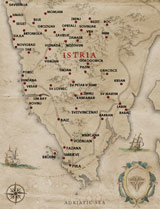
Click on the map
to enlarge


or choose the place
from the menu below
Smrikve Pula Premantura
Brijuni Vodnjan Medulin
Fazana Galizana Vizace
Peroj Svetvincenat Marcana
Bale Kanfanar Mutvoran
Monkodonja Dvigrad Krnica
Rovinj Zminj Rakalj
Lim Bay Sv. Petar u Sumi Barban
Klostar Tinjan Rasa
Gradina Beram Labin
Vrsar Trviz Rabac
Funtana Gracisce Sv. Martin
Sv. Lovrec Pazin Sumber
Sv. Ivan Lindar Pican
Porec Kascerga Krsan
Mali Sv. Andjelo Zamask Klostar
Baredine Cave Motovun Kozljak
Tar Oprtalj Gologorica
Visnjan Zrenj Paz
Vizinada Zavrsje Belaj
Novigrad Grimalda Boljun
Karpinjan Draguc Lupoglav
Dajla Racice Raspor
Brtonigla Sovinjak Slum
Seget Vrh Ucka
Umag Hum Plomin
Savudrija Roc Brsec
Groznjan Buzet Moscenice
Buje Kostel Lovran
Momjan Salez Opatija
Istra Veprinac

Major influences

Rome
Rome
Byzantium
Byzantium
Venice
Venice
Vienna
Vienna
Brioni
Brioni
Tell a friend
and follow us on
Linkedin

Gologorica – Moncalvo di Pisino:”Mikula Gologoricki”


Very nice work and with a little bit of imagination you will recognize the main buildings of the village.

Gologorica is also known for the agritourism Gologoricki Dol that is located in Lukacici in the Gologoricki Dol (Gologorica Valley). People that enjoy good cuisine and the nature love this place.

One way to arrive in the agritourism Dol is to take the road that goes towards left before entering Gologorica. In this place you can enjoy unspoiled natural beauty of the place and the food prepared by the Stojisic family that runs this agritourism farm.

In Gologorica’s photo gallery you will find few pictures of this old village.  


GOLOGORICA – HISTORICAL OVERVIEW

Gologorica is mentioned for the first time in 12th century and with Lupoglav is among the first Istrian villages to be mentioned with Croatian name in medieval documents.

Near Gologorica there was a prehistoric hill fort settlement and also some Roman rests have been found in the 19th and the 20th century.

It is known that in 1102 the lawyer of the Aquileia Patriarchs, Egino, sold Gologorica to another lawyer of the Aquileia Patriarchs, Corrado. After that there are no news about Gologorica until 1360 when the property was owned by Mainardo of Rasch, the Lord of Sovinjak.

Mainardo sold Gologorica before 1367 to Schomberg family, the Lords of Sumberg. At the beginning of the 15th century. Anna Schomberg married Giovanni of Guteneck, the Lord of Wachsenstein (Kozljak) and after her husband’s death she sold Gologorica to the ruler of Pazin, Andrea Schuel. In that document Gologorica was named Mons Nudus.

Schuel gave Gologorica to a Priest and after Schuel died the Emperor Federico III of Austria gave the property to the Priest Antonio di Pisino, who gave it to some other Priests.

In 1750 the last beneficiary of the rights over Gologorica was the abbot Carlo Antonio Biotz who rented Gologorica to Gian Pietro De Franceschi. After Biotz died the Emperor Maria Tereza decided that beneficiary of the feudal rights over Gologorica would be Pican Bishops and they rented the property to the family De Franceschi.

In 1788 Bishop seat of Pican was suspended and Gologorica passed to County of Pazin.

Like most other Istrian border towns and villages also Gologorica was involved in the wars that happened in the region over the centuries.

In 1463 Gologorica was destroyed by the Frankopan army. In 1508 was occupied by Venetians and in 1511 was destroyed by the Turks.

In 19th century after a short period of Napoleon rule was again part of Austria and the Austro-Hungarian Monarchy. Between the two World Wars was part of Italy and after the Second World War became part of Yugoslavia (Croatia).

During the Italian Fascist period in Istria many Istrian families suffered from the regime or had to leave Istria. Fascism in Istria applied various repressive measures mostly towards Slav populations and this created the Antifascist Movement.

The Second World War was a very painful experience for the Istrian population and many innocent Istrians, both Slav and Latin, died during that war.

After the second World War Gologorica became part of Yugoslavia (Croatia). There were three agreements between Yugoslavia and Italy which established that Istria would become a part of Yugoslavia: Paris Agreement of 1947, London Memorandum of 1954 and the Osimo Agreement reached in 1975.

In the first decade after the Second World War many Istrians, especially those living in towns and villages that for centuries were part of the Venice Republic, decided to leave Istria.

In 1991 with the fall of Yugoslavia and the founding of the Republic of Croatia, the internal republic boundaries were recognised as the state boundaries and Gologorica is today part of Croatia.

Hopefully one day Gologorica will be also part of the European Union. You can not change the past but you can try to learn from it. The main aim of the European Union founders was to build a system that could avoid future wars and future refugees in Europe as I explain in COSMOPOLITE.

Link to us

Visit Smrikve

Your name
Your e-mail
Friend's name
Friend's e-mail
Message
Please wait...
Close